Decodables: What, When, Why, and How To

Susan Ebbers is a literacy expert and author of Power Readers and Supercharged Readers, as well as the rhyming picture books, Jamie’s Journey: The Savannah and Jamie’s Journey: The Mountain. She has consulted across the country and continues to work to promote reading, focusing especially on vocabulary and morphological awareness. She served as a primary grade teacher for more than 10 years before moving on to work with adolescents striving to read. In doctoral studies, she focused on vocabulary development and morphological awareness. To learn more, visit, Vocabulogic at https://vocablog-plc.blogspot.com.
“Decodable books” is a term frequently heard in literacy circles. Decodable books are beginner books, constrained, limited, intentionally written with words a learner can sound out using the phonics skills they’ve already learned, and with limited irregular words. Learners practice the skill of decoding with these texts. They also practice a few essential high-frequency sight words.
Example: Thump = th + u + m + p.
Focus pattern: Short vowel words ending in a consonant blend: mp, nd, nt, ld, st.
Sight word focus: Began, “began to”
Decodable Text example:
Jim sat on a stump. He held a drum on his lap. Jim began to tap on the drum with his hand. Thump, thump went the drum. Jim began to tap the drum fast. Thump, thump, thumpity-thump.
Six kids ran up to Jim. The kids began to clap hands. The kids began to chant. Then the kids began to jump. Thump, thump went the drum.
Some decodable books also provide valuable practice in morphology, by including a focus on word structure, including prefixes, suffixes, bases, and compound words. Example: Integrate -er suffix as in: Faster and faster went the drum. Faster and faster went the kids. Thump, thump, thumpity-thump.
Decodable texts and leveled texts differ in several key ways. Both types of text serve a very different purpose. In essence, decodable texts are created to practice and promote the skill of decoding, while leveled texts are not. See this comparison chart for more details about the differences between decodable and leveled reading material.
When Are They Used?
Decodable books are used when children are skilled enough to experience success, not frustration, with the book. Educators use decodables when children are learning to read, when they are learning to decode, to apply phonics lessons to words in connected text. Educators use them as students take their first steps into reading, to develop good reading habits and a sense of confidence, or self-efficacy. Sometimes, educators use them with older students and English language learners. Decodable texts serve a specific purpose, aiming for specific goals in primary grades. Based on diagnostic assessment data, teachers might use them with older students and English-language learners. Decodable books are useful practice tools when learning to read.
Why Use Them?
For practice. For motivational, can-do self-efficacy. Decodable books work best when they directly support explicit phonics and morphology instruction. These basic books are not intended as a substitute for phonics instruction, but rather as follow-up practice. With decodables, developing readers apply the decoding lessons they have been taught. They are practice tools, similar to riding with training wheels or playing piano scales.
Decodables promote good reading habits. With decodables, emergent readers practice an essential skill—decoding—focusing first on the letters within a word, the phonics patterns, the spelling or orthography (Ehri, 2020; Foorman, 2023). Good readers examine the within-word patterns; they do not immediately guess at words based on picture clues, context, previous semantic and syntactic information, or personal experience. Decodable texts promote the habit of decoding, examining the letter patterns, not guessing.
Once decoding skill begins to mature, some decodable series gradually add morphological word structure, integrating basic prefixes, suffixes, and compound words. Morphology is a key component of literacy (Apel, 2017; Brady & Mason, 2024), yet too often it is left out of decodable books. Morphological awareness (MA) is associated with literacy, and a recent meta-analysis yielded a strong relationship between MA and reading comprehension in children (Liu, Groen, & Cain, 2024).
For example, Power Readers are beginner decodable books and Supercharged Readers are slightly more advanced decodable and demorphable chapter books. When I was creating these two sets of decodables, I strove for interesting and varied material that would allow children to practice their nascent skills in both phonics and morphology. Additionally, the books build fluency, vocabulary and comprehension skills, and promote self-efficacy. That “can-do” feeling is uplifting, essential, and highly motivating (Sylvia, 2008).
How To Use Decodable Readers?
Decodable readers should be used deliberately and intentionally with planning and forethought. Not as random books made available to read whenever you want, as with library books. These steps provide insight into how to use decodable readers.
Seven Steps For Use
- Teach the phonics pattern thoroughly, using systematic, sequential, explicit instructional techniques (Ehri, 2020). Ensure the student demonstrates the ability to blend and segment words with that phonics pattern. Present the book to the reader as a reward and a bonus after learning to decode words with the corresponding pattern. Ensure a successful entry into reading.
- Teach and review the sight words used in the book (aka the high-frequency Dolch list words, in Power Readers and Supercharged Readers called the Heart Words).
- Distribute the decodable book and have students find all the words that contain the targeted phonics pattern, or morphological pattern. They could highlight the words, or shout them out, or write them on paper.
- Briefly discuss the theme of the book, for example: “This is a book about flying on a jet airplane from one city to another.”
- During small-group instruction, have students read the book aloud to the teacher. It may help to have the children point to each word as they read. Use a finger or the eraser-end of a pencil. It is easy to get lost on a page. Pointing helps children track and creates a more concrete link between the eye and the page. It helps children focus on the word and the letters within the word (UFLI, 2024). Provide help as needed, but allow students to attempt to self-correct and sound it out, even if it takes a moment. Avoid round-robin reading (in order by seating) as children tend to zone out, focusing only when it is their turn.
NOTE: If reading is quite laborious, find a natural place to stop for the day, or take a break. Do not allow the child to over-tire and become frustrated, because failure is highly demotivating (Sylvia, 2008). Briefly discuss the story. Ask general overview questions as well as text-specific questions. To develop good study habits and emergent text-search skills, instruct the student to find the answer in the book, and to read that sentence back to you or to a partner.
Example: What color is the dog? How do you know for sure? Find and read the sentence in the book that tells the answer. (Provide scaffolding if needed by stating the page number. “Look at page 3 for the color of the dog. Read the sentence aloud.”)
Eventually provide a writing challenge as shown in this Book Work graphic: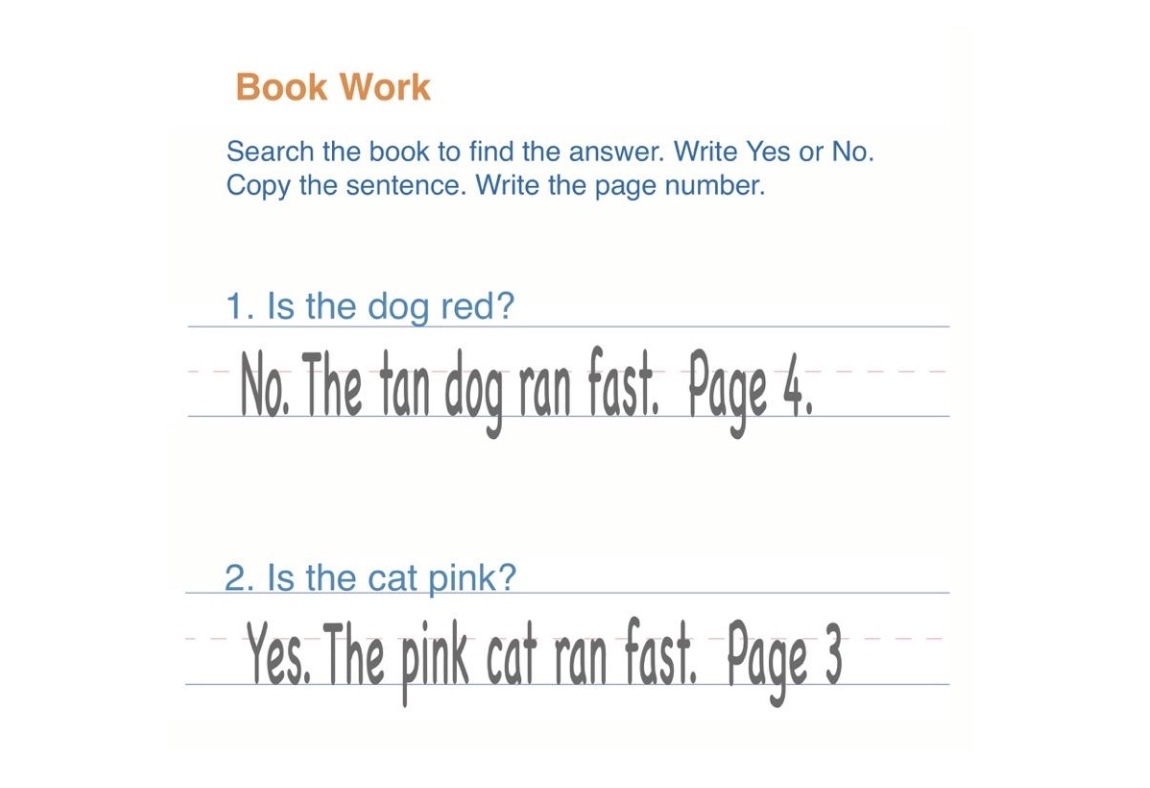
- Within a week or two, have the children revisit the same book again several times, to develop decoding, fluency, and self-efficacy. Plan time for this—reap the rewards of practice. Students could read their book to a reading buddy, during independent reading time, to a parent or sibling, or into a recorder as a center activity. Choral reading and stop-and-go reading also are options. Cheer them on for reading more easily each time they revisit the book.
Finally, across the weeks, track progress. Use the handy-dandy phonics screeners available on the web and through most major reading curriculum publishers. Throughout the year and along the way, it is important to monitor growth and chart progress. Assessments are helpful tools for a reading teacher. Measure fluency progress with Oral Reading Fluency assessments (Hasbrouck & Tindal, 2017). Growth feels great. Success promotes interest and self-efficacy (Sylvia, 2008). Congratulate the kiddos on reading more fluently!
References
Apel, K. (2017). Morphological Awareness Development and Assessment: What Do We Know? Perspectives on Language and Literacy, 43(2), 29–34.
Brady, S., & Mason, L. H. (2024). A Literature Review of Morphological Awareness Interventions and the Effects on Literacy Outcomes. Learning Disability Quarterly, 47(1), 16–29. https://doi.org/10.1177/07319487231171388
Castles, A., Rastle, K., & Nation, K. (2018). Ending the reading wars: Reading acquisition from novice to expert. Psychological Science in the Public Interest, 19(1), 5–51. https://journals.sagepub.com/doi/full/10.1177/1529100618772271
Ehri, L. C. (2020). The science of learning to read words: A case for systematic phonics instruction. Reading Research Quarterly, 55(Suppl. 1), S45–S60.
Foorman, B. (2023). Learning the code. In S. Cabell, S. Neuman, & N. Patton Terry (Eds.). Handbook on the science of literacy (pp. 73–82). New York, NY: Guilford Press. 000-Cabell_Book.indb (thereadingforum.com)
Hasbrouck, J. & Tindal, G. (2017). An update to compiled ORF norms (TechnicalReport No 1702). Eugene, OR, Behavioral Research and Teaching, University of Oregon
Liu, Y., Groen, M. A., & Cain, K. (2024). The association between morphological awareness and reading comprehension in children: A systematic review and meta-analysis. Educational Research Review.
Silvia, P. J. (2008). Interest—The Curious Emotion. Current Directions in Psychological Science, 17(1), 57–60. http://www.jstor.org/stable/20183249
UFLI/University of Florida Literacy Institute (June 11, 2024). The benefits of finger pointing for developing readers. Web article retrieved June 1, 2026 from https://testing.thereadingspecialists.org/testing/category/research/